


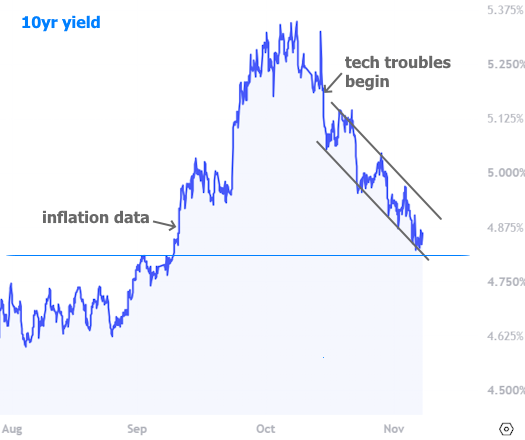
Mortgage rates ended this week at their lowest levels since September 22nd, once again benefiting from trouble in the tech sector. But the more interesting development was their ability to hold those lows despite a jobs report that normally would have pushed rates higher.
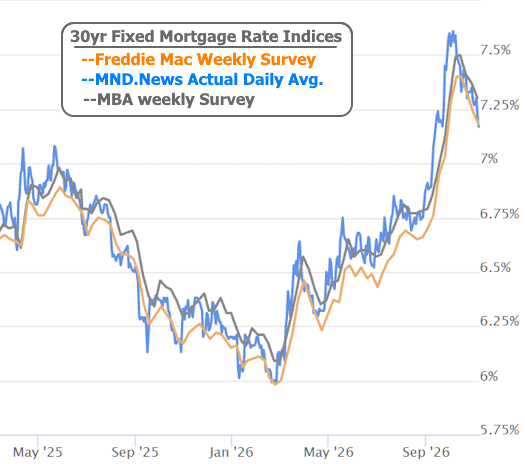
Last week, we noted that tech concerns could keep supporting lower rates, while stronger economic data could work against that improvement. This week delivered both. Thursday brought a massive tech sell-off that helped drive bond yields and mortgage rates lower. Friday brought much stronger job growth than expected, yet mortgage rates barely budged.
We also noted that a bad day for the NASDAQ doesn’t guarantee an equally good day for mortgage rates. That distinction became even more apparent this week. By Thursday, the NASDAQ had fallen roughly 14% from its October highs, but each additional round of selling was producing a smaller benefit for rates.
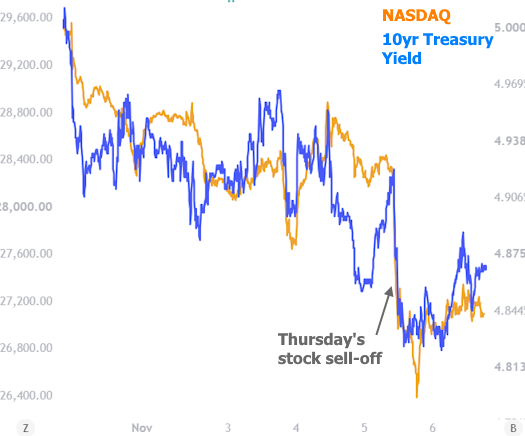
Zooming out and using different scaling in the chart allows for a better comparison of relative movement in stocks and bonds:
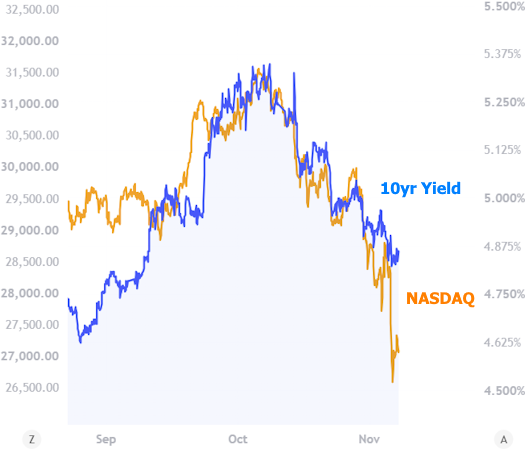
Why does tech still matter so much?
The AI boom has involved enormous spending and borrowing. If investors become less confident in that growth, they can move money toward safer investments, including the bonds that help determine mortgage rates. A slower pace of spending could also mean less economic growth, less inflation pressure, and fewer corporate bonds competing for investors’ dollars.
This week’s midterm elections may have added to those concerns if investors viewed the results as creating more obstacles to data center construction. That’s a possible connection, rather than a definitive explanation for the selling. Markets were already questioning the pace and sustainability of AI investment before the election.
Why didn’t the jobs report push rates higher?
Employers added 165,000 jobs in October versus expectations for only 65,000. The unemployment rate also declined, even as more people participated in the labor force. This was a strong report, and stronger employment data typically puts upward pressure on rates.
Bonds initially reacted accordingly, but most of that reaction disappeared within minutes. Mortgage rates ultimately held steady.
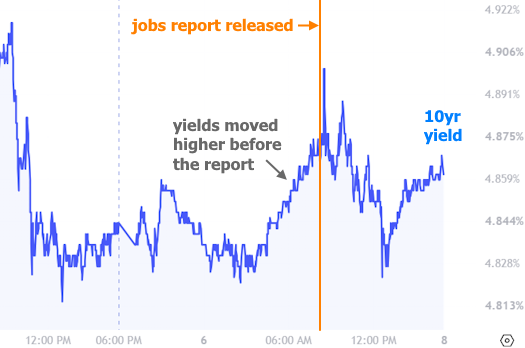
There are several plausible explanations. The Fed recently emphasized inflation as its main concern. Investors have also been paying more attention to the unemployment rate, which delivered a smaller surprise than the job count. And although tech stocks bounced on Friday, the recovery was modest compared with Thursday’s losses.
But there’s an important distinction between explaining a surprising result and predicting it. Knowing the jobs numbers ahead of time would hardly have made unchanged mortgage rates the obvious bet. These explanations help make sense of the reaction after the fact. They don’t make it any less unusual.
There’s also a timing issue. October’s employment and inflation data cannot yet tell us much about the consequences of this week’s sudden shift in investor confidence. If bonds are treating the tech sell-off as an early warning about future growth, strong reports describing the recent past may carry less weight than usual.
What could test that resilience next week?
Tuesday’s Consumer Price Index (CPI) is the biggest scheduled event. With the Fed emphasizing inflation, CPI arguably has more potential to move rates than the jobs report did this month. Cooler-than-expected inflation could reinforce the recent improvement. A hotter reading could challenge it, even if tech remains under pressure. Recall that the CPI release in early September helped kick off the run up to longer-term rate highs.
Wednesday’s Veterans Day bond market closure adds another wrinkle. Traders adjusting their holdings around the holiday could make movement surrounding CPI less predictable.
Tech remains a key consideration. Further weakness could continue helping rates, while a substantial recovery could remove some of their recent support.
For now, borrowers have another week of improvement in hand, along with an encouraging ability to withstand strong economic data. Next week will test whether that resilience extends to the inflation side of the equation.
